When I was starting the ChickN ProwlR, which is a robot with a goal to stop our chickens from laying eggs on the ground, I was looking into motor shields. My IA teacher and I tested my 12v motors for amperage, and with a quick glance at the Adafruit Motor Shield we thought it would do the job but we were surprised.When I looked at the Adafruit Motor Shield its spec sheet suggested a pretty good motor driver with an easy to use stackable design that could stack up to most as much motors as you could ever possibly think of using.When I finally got to the stage of testing the motors I found to my surprise that the Adafruit Motor Shield couldn’t handle my motors. Granted I was an idiot and had four motors on it completely forgetting the 3 amp peak😬. But, the motor Shield still was alive in the end.So, I bought another one and I was kinda thinking that I might need more than that but I didn’t want to be spending $25 on a motor Shield. Then the inevitable happened. The 4 motors were still pulling to many amps off of the shields and weren’t working.By then I was getting a little worried but I was still optimistic when I looked at the spec sheet. It stated that the Shield could supple up to 1.2 amps per channel with a three amp peak across the 4 channels. My motors drew a max current of 1.2 amps per motor and I thought that the Shield could probably even survive a little more than that but I was slightly doubtful due to the previous experience. But I bought 2 more shields.So, I stacked the shields together and tried to run some motors. Then my heart sank, and I saw money swirling down the drain. The motors would run for a couple minutes and then start to slow, slow, and slow some more until the finally staked and the power led on the shields was really dim.Then I decided to do some in depth digging into the Adafruit Motor Shield and what I found stopped me in my tracks. Many forums were saying that the Shield couldn’t handle even close to 1.2 amps over a long period of time and that it can only achieve 1.2 amps for a very short period of time . I WAS PISSED! I had spent a little over $100 dollars on a practically useless motor Shield. It just goes to show that you should do your in depth research ahead of time.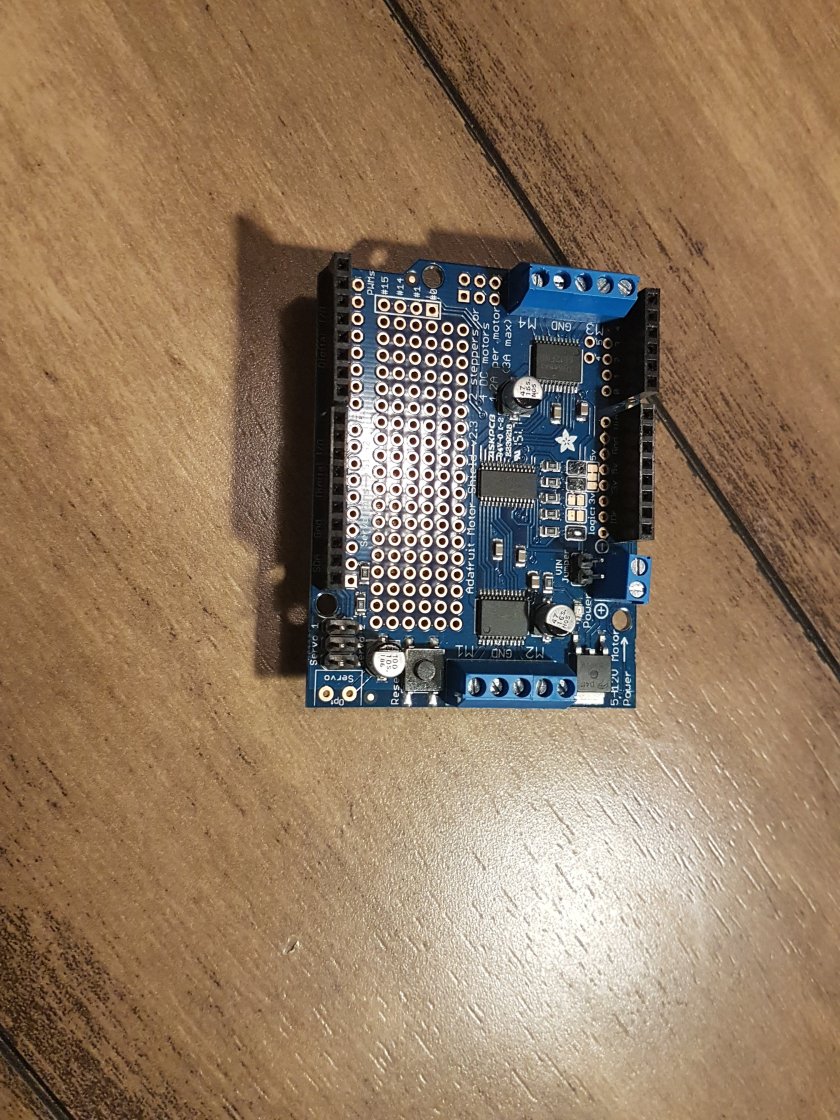
 Thanks for reading!♥️View the Adafruit Motor Shield v2 on AdafruitCheck me out on Instagram and Snapchat at codethejourneyEmail: codethejourney@gmail.com
My Thoughts on Reeborg
So, I don’t know how many of you know about Reeborg, but I am going to talk about and maybe it will give you reason to use in the future.
If you are familiar with scratch, the platform developed by MIT then it would be easy to say that Reeborg coding is a step up from that although there are lots of limitations!
The Reeborg coding platform is real programming where you can program in Python, Java and a few others. The reason that it’s a step up from scratch is that it’s not drag-and-drop, you actually have to type out the code although there is a drag and drop function.
Reeborg is all about coding a robot to get it to do a certain task like pick up objects or close a window! On CS20.ca there is a modified Reeborg environment with challenges you can do although it’s not super modded.
The thing I found, being g familiar with Arduino is that Reeborg is really easy to get a hold of and relatively quick to program. It forces you to think outside the box in various situations as reeborgs functions are very limited, for example: it can only tur left!
Anyways, I really like it and would recommend using it if you have a feeling you want to try Python. It gives you a little boost on that path and makes the path to becoming great at Python so much easier, until next time, thanks for reading!
Python
I just started using Python in CS20!!! And these are may thoughts…..
To me Python is an easy to understand and implement programming language. Most of the code is straight forward and self explanatory as the built in commands don’t have wacky names and if you are familiar with C++ it should be pretty easy to get started.
I started out learning about the command math terms which I mostly knew about except for how to square a number and a few other nifty tricks.
I learned about the while loop which repeats until the while statement you wrote returns as TRUE. I learned about printing a value which is how you can get Python to communicate something to you. I also learned about Input where you can type so etching in and get Python to respond a certain way. I will give some more in depth details later, and share the project I am working on. Which is an assignment I got, Guess the Number.
See you soon!
Check me out on Instagram: Code The Journey, Youtube, and my podcast:Code The Journey
My Biggest Beef About Arduinos
In this blog post I am going to explain what I dislike about the Arduino boards and what I feel should/could be changed in the Arduino. This is not about explaining all my likes and dislikes, that will come later, but it is about explaining what for some reason made me feel a little sketchy around Arduinos for a month and that stopped me from using Arduinos and Arduino like boards for a while which is a little unfounded but still unsettled me.
Ok, now to the meat and potatoes! I will get straight to the point, I don’t like the fact that the Arduino fries insanely easily. Ok, I admit that a few times that they fried I was being dumb like powering it through the five volt pin which bypasses the 12v regulator and I was pounding 12v into the board and fried it and a nice burnt smell started coming off the board in a cloud of grey smoke.
There are many possible ways to fry an Arduino like using way to much volts. The Arduinos voltage regulator is puny and some other companies put massive ones on there boards. But I hope Arduino can do this some day and then undercut the competition. I wish they could support a little more than 12v and that would help beginners like me use and feel a little more safe with these boards. I know, I know, your saying this guys an idiot! But can I help how I feel? Anyways its not too big a problem but I voiced my opinion.
YouTube Channel
I have launched a YouTube channel that will document my journey through programming and a few other areas of my life! Check it out.
The Adafruit Motor Shield v2: My Experiences and Impressions
When I was starting the ChickN ProwlR, which is a robot with a goal to stop our chickens from laying eggs on the ground, I was looking into motor shields. My IA teacher and I tested my 12v motors for amperage, and with a quick glance at the Adafruit Motor Shield we thought it would do the job but we were surprised.
When I looked at the Adafruit Motor Shield its spec sheet suggested a pretty good motor driver with an easy to use stackable design that could stack up to most as much motors as you could ever possibly think of using.
When I finally got to the stage of testing the motors I found to my surprise that the Adafruit Motor Shield couldn’t handle my motors. Granted I was an idiot and had four motors on it completely forgetting the 3 amp peak😬. But, the motor Shield still was alive in the end.
So, I bought another one and I was kinda thinking that I might need more than that but I didn’t want to be spending $25 on a motor Shield. Then the inevitable happened. The 4 motors were still pulling to many amps off of the shields and weren’t working.
By then I was getting a little worried but I was still optimistic when I looked at the spec sheet. It stated that the Shield could supple up to 1.2 amps per channel with a three amp peak across the 4 channels. My motors drew a max current of 1.2 amps per motor and I thought that the Shield could probably even survive a little more than that but I was slightly doubtful due to the previous experience. But I bought 2 more shields.
So, I stacked the shields together and tried to run some motors. Then my heart sank, and I saw money swirling down the drain. The motors would run for a couple minutes and then start to slow, slow, and slow some more until the finally staked and the power led on the shields was really dim.
Then I decided to do some in depth digging into the Adafruit Motor Shield and what I found stopped me in my tracks. Many forums were saying that the Shield couldn’t handle even close to 1.2 amps over a long period of time and that it can only achieve 1.2 amps for a very short period of time . I WAS PISSED! I had spent a little over $100 dollars on a practically useless motor Shield. It just goes to show that you should do your in depth research ahead of time.

Thanks for reading!♥️
View the Adafruit Motor Shield v2 on Adafruit
Check me out on Instagram and Snapchat at codethejourney
Email: codethejourney@gmail.com
How the ChickN ProwlR Project Began!
This is a short blog on how I started the ChickN ProwlR, how my biggest project so far began!
We had some oldish chickens and their production was going down, so we purchased some new ones. The new ones had a problem however.
Our new chickens laid their eggs all over the floor of the coop instead of in the raised boxes. This was a problem as eggs laid on the floor of the coop are directly exposed to more bacteria, l and more prone to breakage. This increased chance in breakage also added another problem to the mix. The chickens started eating some of the eggs and would begin to peck at the shells of laid eggs.
My Dad read an article in a farming magazine about robots on the farm and in the coop. He then proposed to me that I could possibly make a robot to rectify our problem as he knew about my interest in robotics and programming. I decided to give it a go, and let me tell you that the journey has been far from smooth and I will be sharing that part of the journey in upcoming posts!! See you next time!
Visit me on Instagram @codethejourney
The Journey Begins
Thanks for joining me!
Hey guys! This is my first blog post and I am excited to welcome you to Code The Journey!
This is a place where I will be documenting my journey through programming, codeing and electronics! I hope you enjoy, and stay tuned for future blog posts!
You can also see me on Instagram @codethejourney

 Code The Journey